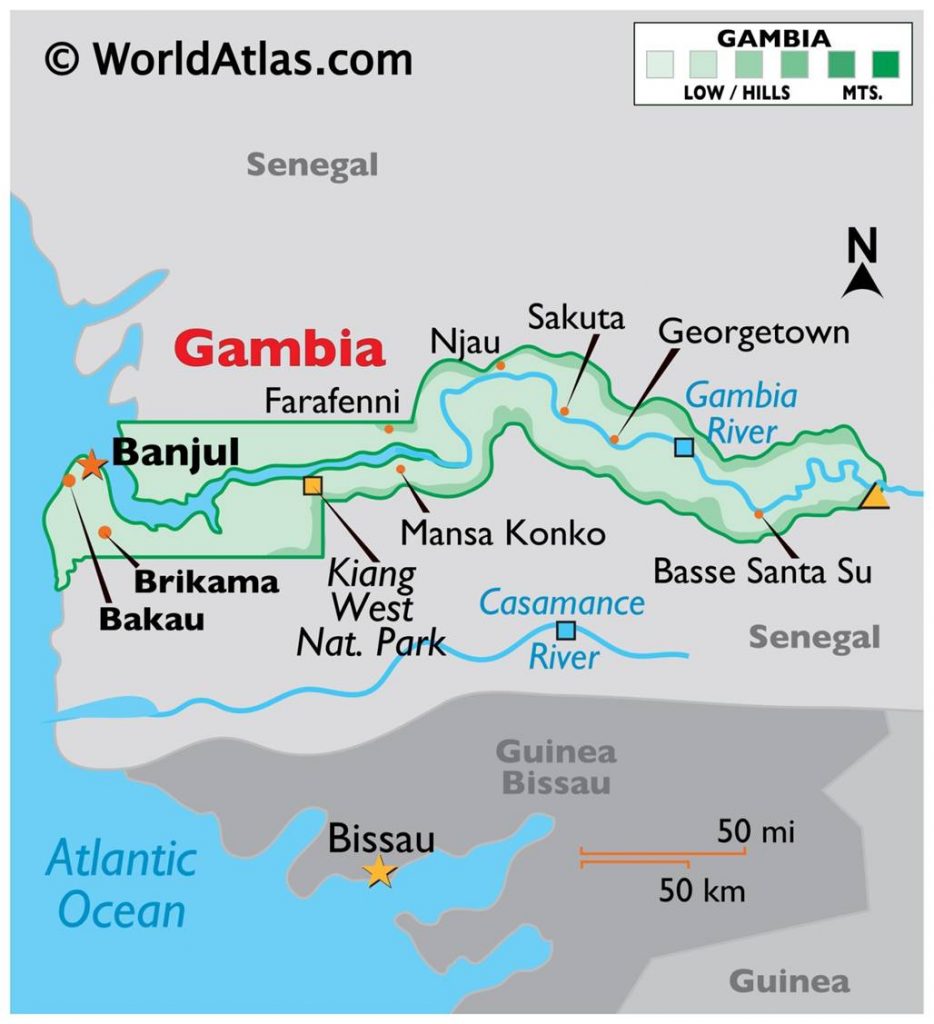
- Nicknamed the Smiling Coast of Africa, the Gambia stretches 450 km (280 miles and between 15-30 miles wide) along the Gambia river, the country is surrounded by Senegal, except for a 60-km Atlantic Ocean front.
- The country is one of the smallest in Africa, covering about 10.7 thousand square km and has a population of 2.5 million. With 176 people per square km, it is one of the most densely populated countries in Africa.
- Including the word “the” in front of its name was originally to reduce confusion with similarly named Zambia and that convention continues.
- The capital is Banjul
- English is the only official language. (French in Senegal)
- According to Wikipedia there are 21 national languages, with Mandinka being the most used.
- Currency is Dalasi
- Main export is peanuts
- In 2022, the poverty rate climbed to 53.4% in urban areas but, in rural areas it’s almost 70%
- 50% of the population doesn’t have access to electricity
- 2019 stats -96.4% are Muslim, 3.5% Christian (mostly Catholic), 0.1% other
- In 2024 the average life expectancy is 64 years male, 68 years female
Taken from the 2023 Unicef Report
- Only 88% of the population in urban areas and 67% in rural areas have access to safe drinking water in households.
- Access to at least basic sanitation remains at about 47% and the proportion of households with at least basic handwashing facilities also remained unchanged, at 18% in 2020.
- According to the latest national data, the prevalence rate of children experiencing violence remains high at 89%; 26% of married adolescent girls aged 15 to19 years experienced violence committed by their spouse and 14% of women aged 15-49 years experienced either physical or sexual violence.
- In the area of Female Genital Mutilation (FGM), prevalence remains high with 50.6% of girls aged between 0-14 years and 27.3% of girls aged 0-4 years have undergone FGM, with urban and rural disparities. In 2023, UNICEF and partners supported the improvement of child protection case management system including the establishment of child-friendly “one-stop centres”, development of the Gender Information Management System and the development of a new child marriage strategy and action plan.
- 2023 also saw the digitalization of the Gambia Birth Registration system thanks to the strong support from UNICEF and partners.